Reliable Water Leak Service in Crane, TX
Reliable leak detection and repair for Crane, TX. Licensed plumber, advanced equipment, honest work.
Fast Answer
Last Updated: March 22, 2026
Water Leak Services in Crane
Resolv Services delivers professional water leak detection and repair to Crane, TX. We bring the same precision equipment and licensed expertise to Crane that we use across the Permian Basin. A water leak doesn't care how big your town is, and neither does our commitment to fixing it properly.
Properties We Serve
- •Crane homeowners in 1950s-era oil camp slab houses with original copper or galvanized supply lines at end of service life
- •Rental property owners managing Crane County housing stock with limited maintenance documentation
- •Residents experiencing floor warmth, unexplained high water bills, or meter movement with all fixtures off
- •Homeowners dealing with yard line joint failures in sandy-caliche soil where mechanical and corrosion fatigue converge
- •Property buyers conducting pre-purchase plumbing inspections on older Crane homes before closing
- •Commercial property owners on Business 385 needing supply line assessment and repair
Signs You May Have a Leak
- ●Slab leaks in original 1950s copper supply lines embedded in Crane County caliche-and-sand soil
- ●Yard line joint failures at caliche-contact points where uneven soil support concentrates mechanical fatigue
- ●Galvanized supply line interior restriction and joint corrosion in homes built before 1970
- ●Sandy upper soil erosion pulling lateral support away from buried supply lines and concentrating load on caliche base
- ●End-of-life copper degradation producing multiple sequential slab leak events within a short time period
- ●Threaded coupling separation in galvanized lines where zinc coating has been fully consumed at sand-to-caliche transitions
Crane's concentrated stock of 1950s oil camp slab homes shares a consistent failure profile — end-of-life copper and galvanized lines on shallow caliche substrate, producing predictable slab leaks and yard line failures that we service on a regular rotation.
Recent Leak Detection Jobs in Crane
End-of-Life Copper Slab Leak in Crane 1958 Home
Problem: A Crane homeowner noticed her water bill had increased from $65 to $155 over two billing cycles. There were no visible leaks, but the floors near the laundry room felt slightly warmer than normal.
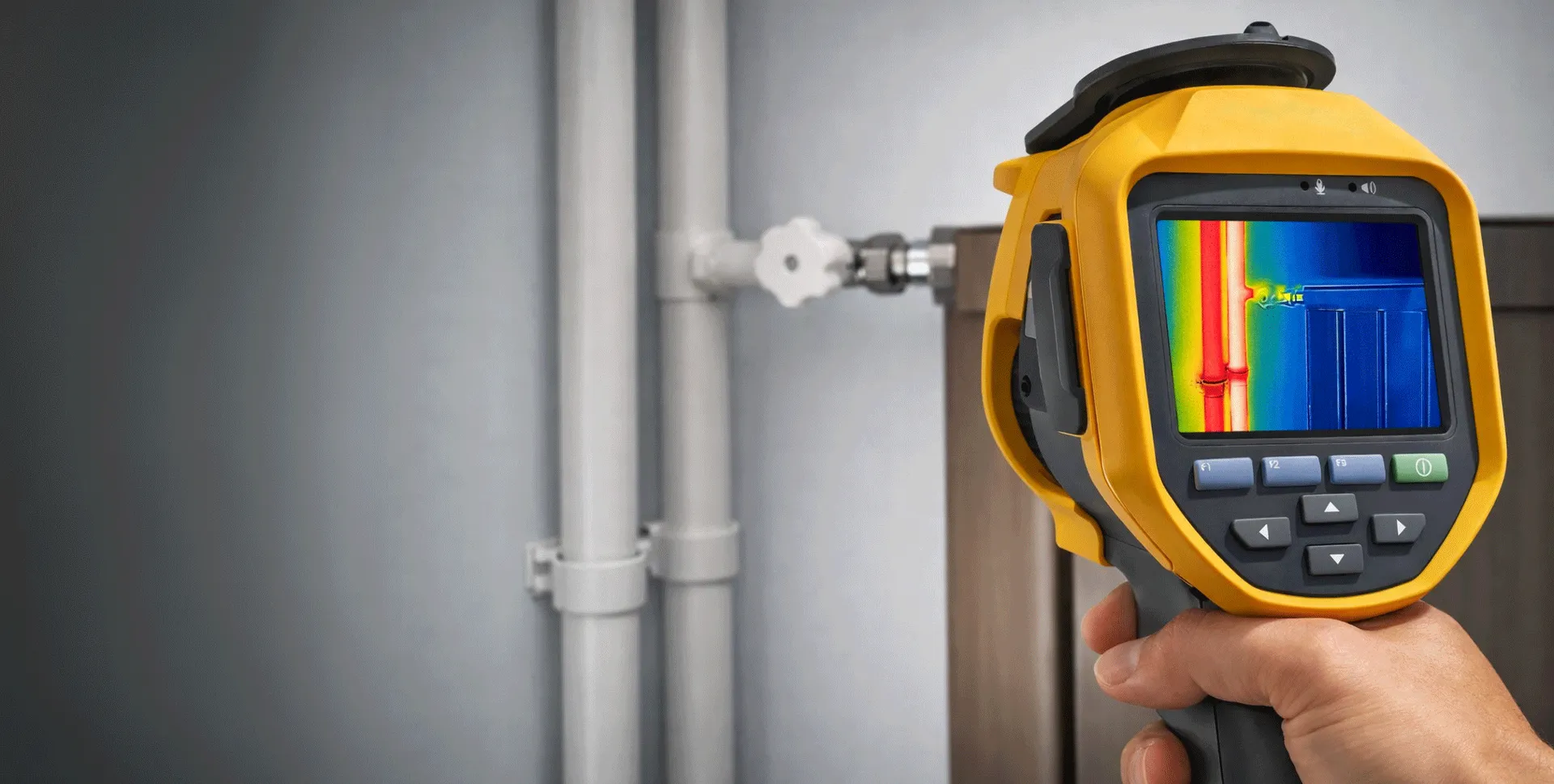
Diagnosis: Acoustic detection located a pressurized slab leak in the hot water supply line under the laundry room floor. The leak was confirmed by thermal imaging — a clear warm zone at the acoustic target. The copper at the water heater connection was heavily oxidized, consistent with slab copper at end of useful life.
Fix: We rerouted the laundry room hot supply through the garage wall and overhead using PEX-A. No concrete was disturbed. The job was completed in under six hours.
Outcome: Water bill dropped back to $62 the following month. The homeowner elected to have us assess the remaining slab copper at a follow-up visit — we found two additional sections showing exterior oxidation and rerouted those branches as a proactive measure.
Caliche-Supported Pipe Joint Failure on Crane Yard Line
Problem: A Crane rental property owner reported that the yard had a wet, soft area near the middle of the front lawn that had persisted through several dry weeks. The tenant reported slightly low pressure but was otherwise unconcerned.
Diagnosis: Meter monitoring with all fixtures closed confirmed an active leak. Acoustic scanning and probing located the failure approximately 14 feet from the house in a section where the supply line was resting directly on a shallow caliche layer with sandy soil on the sides. The threaded coupling at that point had separated from corrosion and mechanical fatigue at the caliche contact edge.
Fix: We replaced 20 feet of the galvanized supply line — the section between the nearest meter-side fitting and the foundation entry — with polyethylene pipe, bedded in clean coarse sand to distribute support evenly rather than resting the line directly on caliche.
Outcome: The wet area in the front yard dried within ten days. The property owner noted the repair was completed faster than she expected given the distance from Odessa.
1950s Oil Camp Housing and Original Pipe Materials in Crane
Crane was built out rapidly in the 1950s and early 1960s to house workers for the area's oil production operations. The housing stock from that era was functional and consistent — slab foundations with copper or galvanized supply lines, built to the standards of the time without anticipation of the 70-year service life they would ultimately be called on to provide. Many of these homes still have original supply infrastructure, which is now reaching or past end of life under Crane County's sandy-caliche soil conditions.
Crane is only 30 miles from Odessa, which means Resolv reaches it quickly and services it frequently. The pipe age profile is similar to Odessa's but the properties are generally smaller lots with shorter supply runs — an advantage when supply line replacement is needed, as the total footage involved is often less than an equivalent Odessa property.
Sandy-Caliche Soil and Pipe Support Dynamics
Crane County sits on a sandy-caliche blend similar to Andrews County but with more uniform caliche layer depth across the community. The sandy upper soil erodes away from buried pipes in dry weather and compacts against them during wet periods, creating a seasonal friction-and-release cycle that works at pipe joints over decades. Joints that survive 30 years of this cycling sometimes fail suddenly in year 40 or 50 when the accumulated fatigue reaches the failure threshold.
Caliche layers in Crane are sometimes only 8 to 12 inches below the surface, which creates an additional challenge: supply lines buried at the minimum depth encounter caliche on their underside and sandy soil on their sides and top. The caliche provides a hard base but does not flex — when the sandy sides erode away, the pipe is essentially resting on a hard ledge with no lateral support, a position that concentrates bending stress at any fittings or direction changes.
Pressure Testing and Efficient Detection for Close-in Service
Because Crane is close to Odessa, detection calls here can be handled the same day in most cases. We treat Crane calls with the same thoroughness as Odessa calls — full pressure testing, acoustic detection where indicated, and a complete repair plan before any excavation begins. The proximity means we can also return quickly if a repair reveals an adjacent issue requiring a second trip, which is more feasible for a 30-mile return than for a remote Trans-Pecos location.
The same copper slab line failure patterns we see in Odessa appear in Crane's mid-century housing. Slab leak rerouting through the attic and walls, using PEX to replace abandoned slab copper branches, is the standard repair approach we use in both cities.
Leak Detection Pricing in Crane
Crane is approximately 30 miles from Resolv's Odessa headquarters with no significant travel surcharge for standard calls. Same-day scheduling is typically available, and emergency calls can reach Crane within 45 minutes.
| Service | Typical Range |
|---|---|
| Rental property leak audit (full system pressure test) | $200-$375 |
| Galvanized failure detection and condition assessment | $225-$400 |
| Water bill investigation (meter monitoring + detection) | $200-$375 |
| Slab leak detection in 1950s oil camp housing | $225-$425 |
| Slab leak reroute through garage/attic (PEX) | $1,500-$4,000 |
| Caliche-contact yard line replacement | $1,200-$3,500 |
| Emergency pipe burst repair | $350-$1,300 |
| Pre-purchase plumbing inspection | $225-$375 |
Crane is approximately 30 miles from Resolv's Odessa headquarters with no significant travel surcharge. Pricing reflects Crane's concentrated stock of 1950s oil camp slab homes with end-of-life copper and galvanized supply lines on shallow caliche substrate — a consistent failure profile that we service frequently.
24/7 Emergency Leak Detection — Crane
Call (432) 290-8511 immediately for: slab leak in a 1950s oil camp home on shallow caliche — hot water surfacing through a hairline foundation crack in the living room; galvanized yard line joint failure on a crane county rental property sending water across the front yard and into the street; copper supply line fatigue failure at the water heater connection in a company-built home near the refinery — flooding the utility area; whole-house pressure loss from a corroded galvanized branch hidden inside a wall cavity of a 1955 crane home on gaston street.
TX License #42668 • Insured • Shallow caliche substrate in Crane requires specific pipe bedding with coarse sand to distribute support evenly and prevent the replacement pipe from resting directly on the hard caliche ledge • Oil camp-era homes in Crane often have non-standard pipe routing from original construction — as-built documentation is provided with every repair to map the updated supply system
How Leak Detection Service Works in Crane
Crane jobs are dispatched from Odessa with short response times similar to mid-Odessa scheduling. We bring standard slab detection equipment on every Crane call given the prevalence of mid-century slab housing.
Call and Describe
Tell us the issue — warm floors, climbing water bill, wet front yard, low pressure. Crane's housing stock is predominantly 1950s slab construction, so if you know the approximate decade your home was built, that helps us prepare the right detection approach.
Quick Dispatch from Odessa
Your technician heads south on SH-385 from our Odessa headquarters, reaching Crane in approximately 35 to 40 minutes. Same-day scheduling is typically available, and emergency calls can reach Crane within 45 minutes of dispatch.
Slab and Caliche Assessment
We evaluate whether the failure is in the slab copper, the yard line, or a wall-routed galvanized branch. Crane's shallow caliche layer creates a specific failure pattern — pipes resting on hard caliche with eroded sandy soil on the sides lose lateral support and crack at fittings along the caliche contact edge.
Detection with Appropriate Methods
Acoustic and thermal detection are deployed based on the suspected leak type. For slab leaks, thermal imaging works well in Crane's 1950s slabs because the concrete is relatively thin. For yard lines on caliche, we use acoustic scanning with probing to confirm the soil support condition at the failure point.
Repair Addressing Root Cause
Slab copper reroutes abandon the failing embedded line permanently. Yard line replacements are bedded in coarse sand to distribute support evenly rather than resting the new pipe directly on the caliche ledge that caused the original failure. All repairs are pressure-verified.
Report for Owners and Managers
Written documentation covers detection findings, repair scope, materials, and warranty. For rental property owners, the report is formatted to support maintenance records and includes a condition rating for the remaining supply infrastructure.
Why Crane Homes Develop Leaks
Crane's dry, alkaline soil and hard water supply work together to create persistent leak risks for homeowners. The soil dries and contracts during summer, pulling away from buried pipes and leaving them unsupported. The hard water slowly corrodes copper lines from the inside. Many Crane homes built during oilfield expansion decades are now reaching the age where these combined factors produce failures.
Water Leak Detection — Slab and yard line diagnosis for Crane's homogeneous 1950s oil camp housing stock where copper and galvanized supply lines have reached end of life on shallow caliche foundations.
Electronic Leak Detection — Thermal imaging through Crane's thin 1950s slab concrete paired with acoustic scanning along caliche contact edges where pipe corrosion concentrates from abrasion and support loss.
Yard Leak Detection — Meter-to-foundation pressure testing for Crane properties where original galvanized yard lines have corroded at threaded joints after seven decades in caliche-rich Crane County soil.
Slab Leak Repair — PEX reroute through attic and walls to permanently abandon failing slab copper in Crane's oil camp homes, where the shallow caliche substrate accelerates pipe corrosion from direct contact.
Water Line Repair & Replacement — Yard line replacement with sand-bedded polyethylene for Crane properties where the original galvanized service line rests directly on caliche and has corroded at every contact point.
What Crane Customers Say
"Auden is AMAZING! So very nice, very honest and trustworthy! Auden pointed out that the previous plumber had used incorrect fittings. Top-notch work."
— Lynda Linton
"Very quick! They were even early for the scheduled time. They had the issue resolved within 30 minutes and were very reasonable on the pricing."
— Kelly Dilbeck
"They have been so good about explaining the issue and providing a solution. Honest and straightforward."
— Tammy Huckaby
"Fast and efficient. Had a pipe leak on a Sunday morning. Resolve had someone out that afternoon and fixed in no time! Honest and affordable. Very grateful for their help."
— Skyler Crawford
Leak Detection Service Area — Crane, TX
Crane's soil has a notably high pH, which can cause exterior corrosion on certain pipe materials — particularly copper and ductile iron. Combined with the internal corrosion from hard water, pipes in Crane face a two-front assault that shortens their effective lifespan. When we work on Crane leak repairs, we evaluate both the interior and exterior condition of the pipe to determine whether the failure is isolated or systemic. This assessment helps Crane homeowners make informed decisions about repair versus replacement.
Crane's residential development closely tracks the oil activity in Crane County, with the largest building periods occurring in the 1950s and again in the late 1970s. Homes from the 1950s era almost universally used galvanized steel supply lines, which are now 70 or more years old and well past their functional lifespan. The 1970s construction wave brought copper plumbing, an improvement but still subject to Crane's corrosive water and alkaline soil conditions. A small number of newer homes and remodels in Crane use PEX tubing, which holds up significantly better in these conditions. When Resolv Services responds to a leak call in Crane, one of the first things we determine is the pipe material and approximate age, because this tells us whether the failure is likely isolated or a warning sign of system-wide degradation that warrants a broader conversation about repiping.
Also serving nearby: Odessa, McCamey, Monahans, and surrounding Permian Basin communities.
Leak Detection in Crane
Crane is approximately 30 miles from Resolv's Odessa headquarters with no significant travel surcharge for standard calls.
(432) 290-8511Leak Detection FAQs (Crane)
Call (432) 290-8511 or use our online scheduling at resolvservices.com. We serve Crane regularly and can usually arrange same-day or next-day service for leak detection.
Yes. We handle commercial leak detection in Crane for office buildings, retail spaces, and industrial facilities. Our equipment is capable of tracing leaks through larger commercial plumbing systems.
Most older Crane homes have copper supply lines, with some still running galvanized steel. Newer construction uses PEX or CPVC. The type of pipe affects both the likelihood and nature of leaks, and we're experienced with all of them.
Crane's residential plumbing faces a dual challenge. The town's hard water, often exceeding 20 grains per gallon, deposits mineral scale at every threaded connection and soldered joint in the system. Simultaneously, Crane County's clay and caliche soil contracts severely during drought periods, pulling foundations and the pipes beneath them in different directions. The combination of mineral-weakened joints and soil-induced stress makes supply line connections the most common failure point in Crane homes. Resolv Services addresses both issues by replacing corroded fittings with dielectric unions that resist scale buildup and using flexible PEX connections that absorb ground movement without cracking.
A pinhole leak in a Crane home's supply line can waste 500 to 1,500 gallons per month depending on water pressure and hole size. A constantly running toilet flapper, which many homeowners do not notice, wastes 5,000 to 7,000 gallons monthly. At Crane's municipal water rates, even a small hidden leak adds $20 to $50 to your monthly bill, and the cumulative water damage to subflooring, drywall, and foundation materials costs far more to repair. Resolv Services performs whole-house leak audits for Crane properties using meter-based flow analysis and zone-by-zone pressure testing to identify every active leak, even those too small to hear or see.
Find Your Crane Leak Today — Before the Bill Climbs
Crane jobs are dispatched from Odessa with short response times similar to mid-Odessa scheduling.
Crane slab, yard line & pipe leak specialists — TX #42668